

What is Access Management?
What is access management?
Access management refers to the processes and tools used to control access to systems, applications, and data within an organization. Access management solutions use digital identities toauthenticate users and devices, then grant or deny access based on predefined policies. These systems also monitor and report on access activity to help detect and respond to potential security threats.
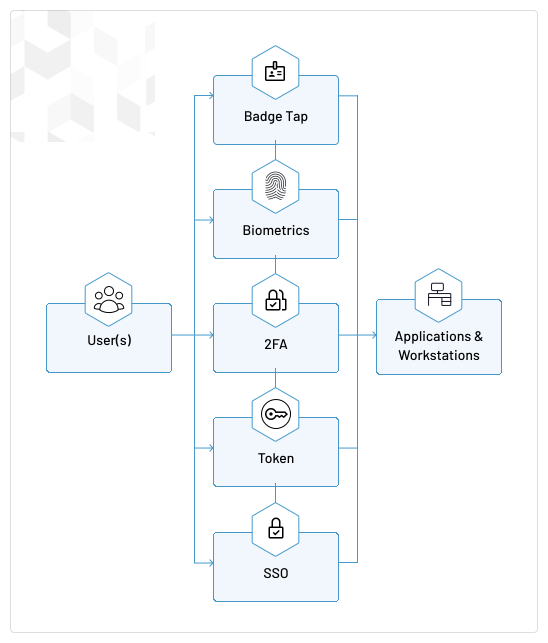
What is the difference between access management and identity management?
Identity management focuses on creating and maintaining digital identities across the identity lifecycle, including provisioning, updates, and deactivation. Access management governs how those identities interact with systems, determining what users can access and under what conditions.
In practice, identity management defines who someone is, while access management defines what they can do. Together, they support federated identity models, enforce role-based access controls, and strengthen cybersecurity identity protection. Managing the identity access lifecycle ensures permissions remain aligned with roles and organizational policies over time.
What is a digital identity?
A digital identity is the collection of attributes, credentials, and contextual signals that define a user, device, or system within an access management framework. This can include usernames, roles, authentication factors, and behavioral or environmental data.
Today, access management for digital identities extends beyond human users to also include risk management for AI agents, mobile devices, and non-human privileged identities, such as service accounts. Within a zero-trust model, digital identities must be continuously evaluated before and during access to ensure consistent enforcement of security policies.
What are permission access controls, and why do permissions change?
Permission access controls define what users can access and what actions they can take within systems, applications, and data environments. These controls are typically based on roles, responsibilities, and contextual factors such as location or device.
Permissions change over time as users take on new roles, projects evolve, systems are updated, or risk levels shift. Effective access management keeps permissions aligned with current needs while maintaining operational efficiency, security, and compliance.
Operational efficiency
Access management ensures users have timely access to the resources they need to do their jobs. As roles and responsibilities change, permissions must be updated to prevent delays, access gaps, or reliance on workarounds that reduce productivity.
Security
Permissions change to reflect evolving risk. Removing unnecessary access, adjusting privileges, and enforcing least-privilege help reduce exposure to insider threats and external attacks. Continuous updates ensure that only authorized users retain access to sensitive systems and data.
Compliance
Regulatory requirements often mandate strict control over who can access sensitive information. As users join, leave, or change roles, permissions must be updated to maintain compliance. Consistent access reviews and audit trails help organizations demonstrate that controls are enforced and up to date.
What types of roles are involved in access management for data or systems?
Access management spans multiple roles across an organization. End users, such as clinicians, public safety officers, and other staff, depend on fast, reliable access to critical systems. IT managers are responsible for configuring integrations, managing access policies, and maintaining system performance.
Security directors and compliance leaders oversee risk, governance, and audit readiness, ensuring that access controls align with regulatory requirements. Procurement managers and administrative teams may influence access management through vendor selection and third-party access policies.
Each role interacts with access management differently, but all rely on a consistent framework to balance security and usability.
Types and examples of access management
Authorization Management determines what resources a user can access and what they can do with those resources once access is granted. This is typically based on policies that consider the user's role within the organization, the context of the access request, and other factors.
Privileged access management deals specifically with managing and monitoring access rights for users with elevated privileges, such as administrators and third parties. Privileged access management tools help secure, control, and audit all privileged accounts and activities.
Authentication management ensures that users are who they claim to be by requiring them to prove their identity before accessing resources. This can involve methods such as passwords, biometrics, smart cards, or multifactor authentication (MFA).
What is SSO?
Single sign-on (SSO) allows users to access multiple systems with a single credential set. Instead of logging into each application separately, users authenticate once and gain access across integrated systems.
Modern SSO solutions are designed to integrate with a wide range of applications while protecting sensitive data and reducing password fatigue. Some also support low-code SSO to reduce development time and simplify integration with legacy systems.
By enabling one login across multiple systems, SSO improves usability while reducing the need for repeated credential entry.
What is passwordless authentication?
Passwordless authentication is an approach that allows users to access systems without relying on traditional passwords. Instead, it uses alternatives such as biometrics, secure tokens, or passkey support to verify identity. Passwordless identity verification reduces reliance on credentials that can be weak, reused, or easily compromised.
By eliminating passwords, organizations reduce common risks associated with password strength and reduce the need for frequent password resets. Passwordless authentication improves both security and user experience by minimizing friction while strengthening protection against phishing and credential-based attacks.
What is modular authentication?
Modular authentication is an approach where authentication methods are built from flexible, discrete components. Organizations can combine MFA, biometrics, and adaptive authentication to elevate security based on user context and risk level.
This flexibility allows security teams to dynamically adjust authentication requirements, strengthening protection without disrupting workflows.
What is tap and go?
Tap and go is a proximity-based, easy authentication method that enables users to access systems by tapping a proximity badge on a reader, rather than manually entering credentials.
In shared workstation environments, this approach supports fast user switching while maintaining security. Technologies such as DESFire badges can enable phishing-resistant MFA while improving workflow efficiency.
What is an access management platform?
An access management platform centralizes authentication and authorization across systems, applications, and devices. It provides capabilities such as SSO, MFA, and biometric authentication within a unified framework.
These platforms support compliance and security requirements while improving usability across desktop and mobile device environments. By centralizing access controls, organizations can enforce consistent policies, reduce administrative complexity, and gain visibility into access activity.

What is identity management software?
Identity management software creates, maintains, and manages digital identities throughout their lifecycle. It supports secure identity verification, provisioning, and deprovisioning, ensuring users have the appropriate access for their roles.
These systems enforce access policies and help reduce password sprawl and sharing. When integrated with access management platforms, they provide a foundation for consistent identity lifecycle management.
What is third-party privileged access management?
Managing third-party access is critical when organizations work with vendors, contractors, or partners that require access to internal systems. Without proper controls, third-party access can introduce significant security risks.
Privileged access management solutions help organizations limit, monitor, and audit external access, reducing exposure while maintaining operational efficiency.
Is access management a replacement for VPNs?
In some cases, access management can serve as a VPN replacement by shifting from broad, network-level access to more precise, identity-based controls. Traditional VPNs often grant users broad access to a network once they are connected. In contrast, access management solutions limit access to only the systems and data required for a specific role or task.
This approach improves workforce access by enabling secure connections from any location or device without exposing the entire network. It also strengthens third-party risk assessment by applying granular controls to vendors and external users. When paired with third-party risk management software, organizations can better manage access throughout the identity lifecycle, including enforcing controls during the vendor offboarding process.
Identity and access management
Identity and access management (IAM) is the broader framework that governs how digital identities are created, maintained, and used across an organization. Within IAM, access management enforces policies that determine how and when users interact with systems and data, ensuring access aligns with roles, organizational policies, and security requirements. Strong IAM solutions should not only support security but also enhance operational efficiency and user experience.
Frequently Asked Questions (FAQ) about Privileged Access Security
Skip list contentWhy is access management referred to by so many different names?
Who are access management solutions for?
Is access management difficult to implement?
What are the core features of an access management platform?
Is access management right for my industry?
What is the difference between VPN and privileged access?
Is privileged access difficult to implement?
What is access control?
Is privileged access a part of identity access management?
What is the difference between IAM and PAM?

Purpose-built access management solutions
Learn why Imprivata is the strategic partner for healthcare and other highly regulated industries.