

What is Privileged Access Security?
Understand how privileged access security (PAS) works, including privilege elevation and delegation, account monitoring, and IT support
Privileged access security, also referred to as privileged access management, is the branch of cybersecurity that focuses on managing digital credentials, or “accounts,” and their permissions. Accounts generally refer to the username and password combination that grants access to a service or system, although there are multifactor authentication (MFA) methods that can serve as an account or identity credential.
At the enterprise level, accounts are provisioned so employees can perform their job responsibilities, or so subcontractors (“vendors”) can perform a temporary or long-term service. Credentials to access a company intranet, cloud-based servers, domain registrars, accounting software, or any other data warehouses that contain sensitive information, should only be given to properly provisioned accounts with the correct permissions.
Privileged access security combines the administration, management, cycling, offboarding, and monitoring of enterprise accounts into a single platform. This makes it easy for Information Technology (IT) departments to see who has access to what, and add, remove, downgrade, or elevate permissions as needed.
What are permission access controls, and why do permissions change?
Permission access controls help IT and cybersecurity professionals monitor usage analytics and ensure activity within a system or database is within the scope of approved actions through privilege elevation and delegation management (PEDM). Onboarding, employee turnover, vendor changes, and the natural rotation of people requiring access means this list of accounts and their permissions can grow, change, and evolve on a daily basis.
What risks does privileged access security software prevent?
Privileged access security software minimizes the risk of dormant accounts, bad actors, phishing, ransomware, and other cybersecurity threats, because account discovery, provisioning, and monitoring is all controlled within a single software platform. Notifications and alerts for anomalous access can help enforce various levels of access control, and provide visibility around who accesses what, and when. This increased efficiency means IT professionals can spend more time on other critical projects, ultimately reducing the total cost of ownership of the privileged access security platform.
How is a privileged access security platform purchased, and how much does it cost?
Privileged access security is procured and purchased through digital identity and access security providers that specialize in cybersecurity and access management. It is often unsustainable or cost-prohibitive for organizations to build their own privileged access security platform, especially given evolving compliance frameworks and audit requirements. There is no one-size-fits-all approach to pricing these platforms; costs vary based on company size and licensing agreements. Organizations should always perform a requirements gathering to understand how they can evolve with the platform, allowing for scale without incurring hidden costs.
Onboarding times for a privileged access security solution can vary based on teams and roles involved, operational needs, the list of accounts, and subcontractor access points. Organizations should always choose a reputable provider that adheres to industry-standard security and privacy protocols.
Your privileged access security provider should:
- Regularly perform audits and maintain HIPAA, NIST, and SOC compliance
- Use Information Security Committees to evaluate risks, drive policies, and implement recommendations swiftly
- Employ solution-level security architects who are responsible for assessing and managing solution-based security practices on a consistent basis
What are the key features of a privileged access security platform?
Credential monitoring
By enforcing least privilege, isolating high-risk credentials, and continuously monitoring privileged activity, a quality privileged access security platform removes the most common paths bad actors use to gain access. The platform can also limit the scope of security issues. Even when credentials are stolen or misused, segmentation and session controls prevent single failures from becoming enterprise-wide incidents.
Unified credential management
Consolidating the management, cycling, offboarding, and monitoring of enterprise accounts in a single platform makes it easy for IT departments to assess activity, and adjust permissions as needed. A central platform also standardizes how privileged access is requested, granted, used, and revoked across on-prem, cloud, and hybrid systems, reducing reliance on ad hoc processes that create policy gaps and exceptions.
Identity verification
When privileged access is tied to verified identities, time-bound approvals, and session monitoring, organizations improve accountability. Centralized logging and session records not only provide evidence that simplifies investigations, but they also reduce audit preparation time and provide auditors with verifiable proof of policy enforcement.
Remote support
A well-implemented privileged access security platform supports modern IT practices like DevOps, cloud automation, third-party access, and remote administration, by allowing necessary privileged actions without exposing credentials or weakening security posture.
What can a privileged access security solution help organizations accomplish?
A well-implemented privileged access security (PAS) solution improves security while streamlining privileged account management for IT teams.
What are the benefits of a quality PAS solution?
- A significant reduction in data breach risk
- Preventing small issues from becoming enterprise-wide security incidents
- Improved threat observability and accountability for high-risk actions
- Faster, cleaner audits, and clear data compliance evidence
- Enabling cutting-edge IT practices without increased risk
- Operational consistency across environments to improve security and compliance while simplifying privileged access management and access controls
How does a privileged access security platform work?
The below diagram visually explores how a privileged access security platform works at a high-level, from credential provisioning to account analytics.

What does a well-implemented privileged access security platform deliver?
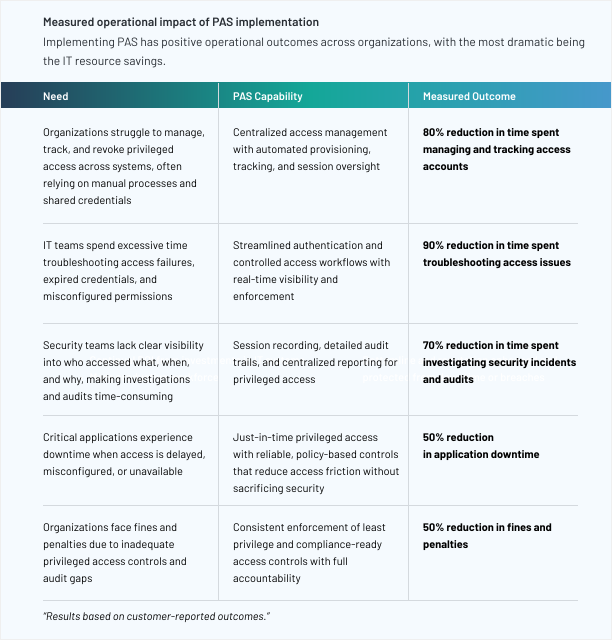
There are many different providers for privileged access security, but a well-implemented solution is paramount to success for reduced risk, team efficiency, and successful adoption. The diagram below visualizes what a well-implemented PAS platform can deliver to an enterprise organization.
How does Imprivata’s Privileged Access Security platform differ, and what sets Imprivata apart from other solutions?
Built to protect critical systems
Imprivata Privileged Access Security (PAS) is built for the realities of modern enterprises: complex environments, diverse users, and high-stakes risk. Rather than treating privileged access as a narrow IT problem, Imprivata addresses it as a core security and business enabler — protecting critical systems while keeping operations moving. The platform secures access across on-premises, cloud, and hybrid environments, enforcing least privilege, identity intelligence, and strong authentication without adding friction for administrators, clinicians, engineers, or third-party users who need fast, reliable access to do their jobs.
Unified access controls
What sets Imprivata apart is its ability to unify privileged access controls under a single, powerful, yet streamlined platform. Privileged account management, secure remote access, session monitoring, and audit-ready reporting work together by design, not as loosely connected tools. This reduces operational overhead, simplifies policy enforcement, and gives security teams a consistent view of risk across the enterprise. Instead of stitching together multiple point solutions, organizations gain a platform that scales with their environment and adapts as access needs evolve.
Regulation and compliance
Imprivata also brings deep expertise in securing some of the most demanding and regulated industries in the world, including healthcare, finance, manufacturing, and government. That experience is evident in the platform’s resilience, compliance support, and focus on real-world usability. PAS controls are strong but practical, designed to be adopted and enforced at scale, not bypassed under pressure. This balance between security rigor and operational efficiency is critical for organizations that need to avoid security theater that looks good on paper but fails in practice. It also helps organizations address strict cybersecurity insurance requirements and fulfill risk management initiatives fundamental to procuring such protections.
The Imprivata Difference
Ultimately, businesses and critical enterprises choose Imprivata because it delivers privileged access security that does what it is meant to do without slowing business operations or overburdening IT and security teams.
Frequently Asked Questions (FAQ) about Privileged Access Security
Skip list contentWhat is the difference between VPN and privileged access?
Is privileged access difficult to implement?
What is access control?
Is privileged access a part of identity access management?
What is the difference between IAM and PAM?
